AI Won't Replace Recruiters, It Will Expose the Average Ones
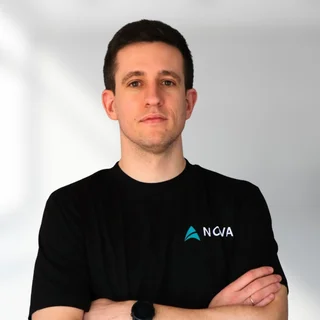
Tiago Santos is VP of Community and Growth at Sesame HR, previously General Manager for Spain and Portugal at Ironhack, and a LinkedIn Top Voice. He joined Ramón Rodrigáñez on the Nova podcast to argue that AI doesn't remove a recruiter's responsibility, it amplifies it.
Updated 6 min read
In this article
Tiago Santos is VP of Community and Growth at Sesame HR and a LinkedIn Top Voice, with more than 15 years in HR and a network of over 60,000 professionals. Before Sesame he ran Ironhack’s Spain and Portugal operations. He’s also the founder of HR Club and HR Community, which between them bring together 3,000+ HR leaders and 10,000+ practitioners across Spain, Portugal and Latin America.
He came on the podcast with Ramón to talk about where AI has already won in recruiting, and he was more blunt about it than most people in his position are willing to be.
The shift from volume to quality
For most of its history, recruiting was a volume game. Post the job, collect the CVs, filter by keyword. Tiago has watched that model collapse in real time.
“Some years ago it was still about volume,” he says. “Now it’s about quality. Now it’s about knowing how to sell your value proposition. Now it’s about having the right tools, because you’re looking for efficiency and good results.”
The paradox is that the explosion of AI tools has made recruiters simultaneously more powerful and more overwhelmed. His answer isn’t more tools, it’s the right one: something that simplifies a decision rather than multiplying data points with nowhere to go.
“Companies don’t have a data problem. They have a clarity problem. They’re obsessed with gathering data, but they don’t know what to do with it.”
Where AI is already better than humans
He’s unusually candid here. In some tasks the machine has won, and pretending otherwise helps nobody:
- Screening large volumes of profiles consistently and without fatigue.
- Identifying patterns across millions of data points, which no human does.
- Automating follow-ups, the task most recruiters skip and the one that quietly kills conversion.
- Structuring candidate information, so nobody starts from scratch every time.
“AI works brilliantly where humans are slow, inconsistent, or overwhelmed,” he says. “In those areas, AI is not the future. It’s already better than us. We have to rely on it.”
Where humans remain irreplaceable
The flip side is equally clear. It breaks precisely where things get most human.
| AI handles | Humans own |
|---|---|
| High-volume profile screening | The final hiring decision |
| Automated outreach and follow-up | Detecting cultural misalignment |
| Pattern recognition at scale | Understanding the ambition behind a CV |
| Structuring information | Ethical dilemmas and edge cases |
| Scoring and ranking | The call when there’s no clear answer |
And then the line that gave the conversation its title. What Tiago calls an uncomfortable truth, one most recruiters haven’t internalized yet: AI doesn’t remove responsibility, it amplifies it. You’re now accountable not just for your own judgment, but for how you read what the machine hands you.
“The danger is not using AI. The danger is delegating thinking to AI.”
On scores, and the “wow moment”
Tiago tried Nova Recruiter before the public launch. His first reaction wasn’t polite approval.
“I don’t rely on new tools at first sight. I have to test them. But when I saw the talent score working across millions of profiles, that was a wow moment.”
What he keeps coming back to is the shift underneath it. Sourcing used to be intuition-driven: search, find profiles, guess which ones might be strong. With a score it becomes insight-driven. You stop searching in the dark with a flashlight and turn the lights on.
“Most of the time, the best candidates don’t apply to your job. You have to go find them. But you don’t know where they are, or whether they’re genuinely good or just good at selling themselves. The talent score addresses that, it tells you where to look. It focuses judgment, it doesn’t replace it.”
That last sentence is the whole argument in miniature, and it’s the same line our Talent Score is built on: ranking by the quality of someone’s experience, education, international exposure and languages, so the recruiter spends their judgment on five people instead of three hundred.
Why human in the loop is a design decision
One product choice he found deliberate: the platform doesn’t force a single AI-or-human workflow. Some recruiters trust the ranking and write their own outreach. Others delegate the messaging and shortlist by hand.
“The hardest thing when you’re building for HR leaders is that each one tends to be different,” he says. “Hypercustomization is hard, but now it’s possible. And you’ve made a very good decision from the very first beginning.”
The three lines he won’t cross
This is where he gets precise. His position is that AI can inform, suggest and prioritize, but the final decision should carry a human signature, because hiring has long-term consequences for candidates, teams and companies, and consequences require accountability.
Three practices he treats as red lines:
- Fully automated rejections. There should always be a human validation step, even for high-volume roles.
- Black-box models with no explainability. If a candidate can’t understand why they were rejected, the system isn’t fair.
- AI making the definitive hiring call. At least for white-collar roles, the final yes or no stays human.
“If it’s not fair, it’s not sustainable. The future of recruiting is not about being faster. It’s about being better, without losing our humanity.”
“Hiring is not just a business decision. There is a human decision within hiring, with long-term consequences. AI should inform. AI should suggest. But it should not decide.”
What AI can’t replicate: the people who’ve been there
Beyond tools, he keeps returning to something a model doesn’t substitute: a community of practitioners who’ve already hit the problem you’re hitting.
“When you ask an HR director about a problem you’re living right now, and they answer from their own experience, that’s a different layer of intelligence. You can ask AI any doubt you have. But human intelligence built through lived experience in communities? That’s even better.”
He’s seen what happens when practitioners share wins and failures in real time: the learning compresses. One person tests a tool, reports back, and fifty others avoid a mistake they’d have made alone.
“You don’t have to test everything. Others will use it and give feedback. And we will all go in the same direction together.”
If you want the practical version of what he’s describing, our team packaged the method for the human half of the process into eleven free AI skills: building the interview guide, scoring candidates against the same rubric, and writing the rejections that still need a person behind them. And the structured version of the scoring he’s talking about is in the interview scorecard.
Frequently asked questions
Will AI replace recruiters?
Tiago's position, and the reason for the title, is that it replaces tasks rather than people, and that the tasks it takes are the ones a mediocre recruiter was spending most of the week on. Screening at volume, chasing follow-ups and structuring notes are now done better by a machine. What's left is reading people, handling the cases with no clean answer, and owning the decision, which is where the difference between recruiters was always visible.
Where is AI already better than a human recruiter?
Four places, in his account: screening large volumes of profiles consistently and without fatigue, spotting patterns across millions of data points, automating the follow-ups most recruiters skip, and structuring candidate information so nobody starts from scratch each time. His argument is that denying this is counterproductive, because those are exactly the tasks where humans are slow and inconsistent.
What should AI never decide in a hiring process?
He names three red lines. Fully automated rejections, with no human validation step even for high-volume roles. Black-box models that can't explain themselves, on the grounds that if a candidate can't understand why they were rejected the system isn't fair. And the definitive hiring call, at least for white-collar roles, which should keep a human signature on it.
What is a talent score and what is it for?
A ranking of candidates by the quality of their track record rather than by whether their profile happens to contain the words you searched for. Tiago's framing is that it moves sourcing from intuition-driven to insight-driven: it tells you where to look first. It focuses judgment, it doesn't replace it, and he's explicit that the decision stays with the recruiter.
Is human in the loop a limitation of the product?
He argues the opposite, that it's a design decision. Some recruiters want to trust the ranking and write their own outreach; others want to delegate the messaging and shortlist by hand. A tool that forces one workflow is making a choice on behalf of a profession where, as he puts it, every HR leader tends to be different.
Sources and method
This article is drawn from Tiago Santos's conversation with Ramón Rodrigáñez on the Nova podcast. His role, career history and community figures are as published on his own LinkedIn profile, checked 22 October 2026. Nova Recruiter figures are Nova's own, as published on novarecruiter.ai.