Pricing and costs · 9 min read
LinkedIn Recruiter Lite: Pricing, Limits and Alternatives
LinkedIn publishes a price for one of its four recruiting tiers, and it is the one with the hardest limits. Every figure below comes from LinkedIn's own help center, including two that most comparison posts get wrong.
Updated

What is LinkedIn Recruiter Lite?
Recruiter Lite is the entry tier of LinkedIn’s recruiting suite, and the only one with a published price. You get a dedicated search layer over LinkedIn profiles, 20+ search filters, and 30 InMails a month to contact people directly. It is built for hiring a handful of roles a year, and it is capped at five licenses.
The thing that defines it is not a feature, it is a boundary: Lite only reaches your third-degree network. More on why that matters below, because it is the limit that decides whether the tier works for you.
How much does LinkedIn Recruiter Lite cost?
$170 a month, or $1,680 a year, for a single license. Licenses two through five cost $270 a month each, or $2,670 a year. Both figures are published by LinkedIn; the other three tiers are not.
The consequence people miss is that the price does not scale linearly. A team of three is $710 a month, not three times $170. A full Lite team of five is $1,250 a month, which is $15,000 a year, and it is still the tier that cannot leave your third-degree network. We broke the full cost per hire down in our LinkedIn Recruiter pricing breakdown.
[!ACTION] count the licenses before you compare any prices. The headline number buys one license, and the second one costs 59% more than the first.
What is included in Recruiter Lite, and what is not
LinkedIn publishes a tier-by-tier comparison, and it is more specific than most of what gets written about it. Here it is, condensed to the lines that change a buying decision.
| Dimension | Recruiter Lite | RPS | RPS+ | Recruiter Corporate |
|---|---|---|---|---|
| Network reach | Third degree only | Third degree + 30 out-of-network unlocks a month | Third degree + 50 unlocks a month | Full member base |
| InMails | 30 a month | 100 per seat, pooled | 140 per seat, pooled | 150 per seat, pooled |
| Search filters | 20+ | 40+ | 40+ | 40+ |
| ATS integrations | None listed | 28+ partners | 28+ partners | 28+ partners |
| Team features | Yes, up to 5 seats. Shared projects and @mentions | Shared projects + 20 collaborator licenses | Shared projects + 20 collaborator licenses | Shared projects + 20 collaborator licenses |
| AI features | None | Base level | Advanced | Advanced, plus Hiring Assistant as an add-on |
| Seat limit | Maximum 5 | Unlimited | Unlimited | Unlimited |
| Published price | $170/mo or $1,680/yr for one license. $270/mo or $2,670/yr for licenses 2-5 | Not published | Not published | Not published |
Every figure in this table is from LinkedIn’s own tier comparison, verified August 2026. Two of them contradict what most comparison posts say: Lite does support a team of up to five, and RPS and RPS+ are not full-network, they are third degree plus a monthly unlock quota.
What is the difference between LinkedIn Recruiter and Recruiter Lite?
Strip the feature lists away and there are two differences that matter. The first is reach: Lite stops at your third degree, Corporate does not stop. The second is assistance: Lite has no AI features at all, while the higher tiers add AI-assisted search and messaging, and Corporate can bolt on LinkedIn’s Hiring Assistant.
Everything else is a matter of volume. Twenty filters against forty. Thirty InMails against a pooled hundred and fifty. No ATS integration against twenty-eight partners. Those gaps are wide, but they are differences of degree. The network boundary is a difference of kind: no amount of filtering finds a candidate the tier cannot see.
And the InMail allowance is worth putting in context, because thirty messages is not thirty conversations. Reply rates on cold InMail sit below 10% on average, and closer to 5 to 8% for senior roles, so a month of Lite realistically buys you two or three replies. We went through why in our breakdown of why passive candidates ignore InMails.
And the middle tiers are worth knowing about, because they are usually described wrong. Recruiter Professional Services and RPS+ do not open the full network. They keep the third-degree limit and hand you a monthly quota of out-of-network unlocks, 30 and 50 respectively. If you need the whole member base, Corporate is the only tier that gives it to you, and LinkedIn does not publish what it costs.
The limit that decides everything: third degree only
This is the part that rarely makes it into a feature table, and it is the one that determines whether Lite works for your desk. Your available talent pool is a function of your own LinkedIn network, not of how many people can do the job.
It bites hardest in exactly the two situations where sourcing is already hard. Senior and passive profiles tend to keep small, curated networks, which puts them further from your third degree, not closer. And hiring into a market you are not embedded in means your network there is thin by definition: you will see fewer candidates, not because fewer exist, but because fewer are inside your boundary.
[!ACTION] run the same search on a colleague’s seat and compare the result counts. The gap is your network limit, and it is invisible from inside your own account: a search that returns 40 profiles looks identical whether the real market is 60 or 600.
What are the cheaper alternatives to LinkedIn Recruiter?
Before comparing tools, it is worth being precise about what you are actually missing, because the two problems have different answers. If it is reach, you need a database that is not gated by your own connections. If it is automation, you need sequences and follow-ups, and no LinkedIn tier includes them: Corporate buys you the network, not the workflow.
[!ACTION] decide which of the two you are short on before you upgrade a tier. Paying for Corporate to solve an automation problem is the most expensive way to not fix it.
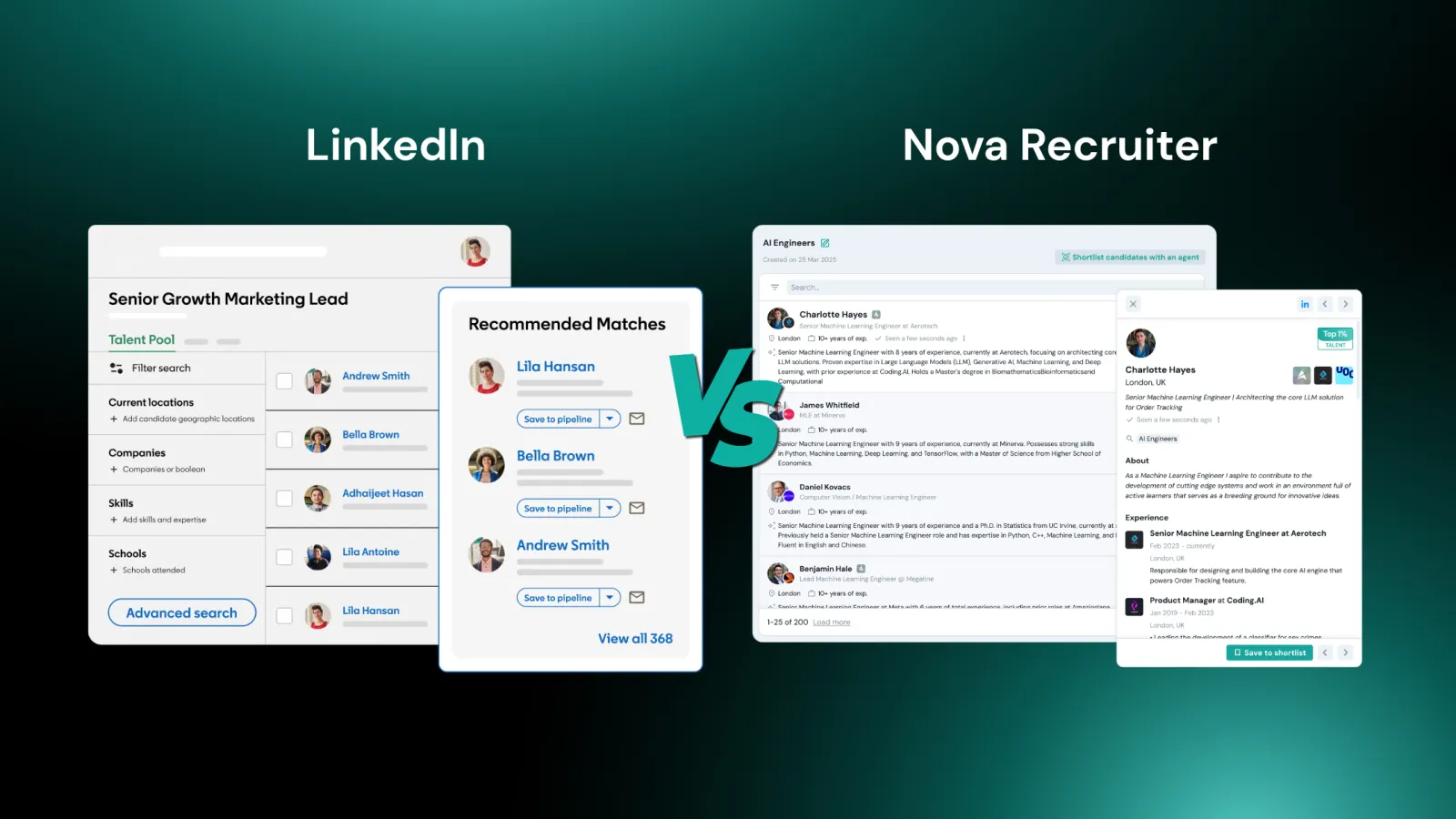
Nova Recruiter is built for both. Search runs over 800M+ public profiles with no network-degree restriction, ranked by Talent Score rather than by keyword presence and profile completeness. Outreach runs across four channels from one place, Nova, LinkedIn, InMail and email, with automated follow-ups, and campaigns get 2.5x more replies than single-channel outreach.
There are four agents covering the workflow rather than a single assistant: one filters the pool against the role, one builds and ranks the shortlist, one writes the outreach, and one handles the reply flow. On sourcing that removes about 98% of the manual time, roughly 20 hours per role.
And the pricing model is the other half of the comparison. Free is €0 with 10 credits, Starter is €49 a month with 50 credits and 1 team member, Growth is €199 with 300 credits and 3 team members. Credits are charged per candidate contacted, so the bill follows the work rather than the headcount, and the price does not go up per user. If you want the wider market, our comparison of the seven main alternatives covers what every vendor publishes.
Recruiter Lite vs Nova Recruiter, feature by feature
| Dimension | Recruiter Lite | Nova Recruiter |
|---|---|---|
| Network reach | Third degree only | 800M+ public profiles, no network limit |
| Ranking | Keyword presence and profile completeness | Talent Score, 150,000+ candidate evaluations |
| Outreach channels | InMail, 30 a month | Nova, LinkedIn, InMail and email |
| Automated sequences | None | Built in, with follow-ups |
| AI agents | None | Four: filter, shortlist, message, response |
| Curated network | None | 25,000+ pre-vetted professionals across 80+ countries |
| ATS integrations | None listed | Gmail, Outlook and the major ATS platforms |
| Pricing model | Per license, capped at 5 | Per credit. €0 Free, €49 Starter, €199 Growth |
Recruiter Lite figures from LinkedIn’s help center, Nova Recruiter figures from novatalent.com/nova-recruiter. Both verified August 2026. A credit is charged per candidate contacted, not per message sent.
When Recruiter Lite is still the right choice
There is a real case for it, and it is narrower than the marketing on either side suggests.
-
You hire one or two roles a year and the people you want are already inside your network. The third-degree limit costs you nothing if your network is the market.
-
You want to write every message yourself. If automation is not the point, you are not paying for something you will not use.
-
You want a predictable subscription under $200 a month for one seat, and the network boundary is not a constraint on the roles you fill.
If any of those three stops being true, the gap widens quickly, and it widens fastest on the roles that were already hardest to fill.
When using both is the strongest setup
For teams running real volume, the answer is often not one or the other. LinkedIn contributes InMail as a channel and, at the Corporate tier, coverage of the full member base for searches where raw volume is the whole problem. Nova contributes the filtering, the scoring, the shortlisting and the multichannel sequences with automated follow-ups.
Used together, LinkedIn is a channel inside the workflow rather than the workflow itself. That is usually the highest-output arrangement, and it is also the honest answer: neither product makes the other pointless.
The bottom line
Recruiter Lite is the only LinkedIn recruiting tier with a published price, and it is priced per license rather than per user: $170 for the first, $270 for the next four, capped at five. What you get is 30 InMails a month that roll over to 120, 20+ filters, team features for up to five people, and a hard stop at your third-degree network. What you do not get is any AI, any ATS integration, or any automation.
So the question is not whether Lite is good value. It is whether your constraint is reach or workflow. Corporate solves the first and LinkedIn will not tell you what it costs. Neither tier solves the second. If you want the message side of that problem, our guide to recruiting message templates has the six that work and the format each channel rewards.
Frequently asked questions
How many InMails do you get with LinkedIn Recruiter Lite?
Thirty a month. They do accumulate if you don't use them, up to a cap of 120, which is four times the monthly allowance. Plenty of comparison posts state that Lite InMails expire each month; LinkedIn's own help center says they roll over to that cap. The other tiers are pooled across seats: 100 per seat on Recruiter Professional Services, 140 on RPS+, and 150 on Corporate.
How much is LinkedIn Recruiter Lite?
$170 a month, or $1,680 a year, for a single license. Licenses two through five cost $270 a month each, or $2,670 a year, and Lite is capped at five licenses in total. That means the price does not scale linearly: a team of three is $710 a month, not three times $170.
What is the difference between LinkedIn Recruiter and Recruiter Lite?
Reach and automation. Lite is limited to your third-degree network with 20+ search filters, no ATS integrations and no AI features. Recruiter Corporate opens the full member base with 40+ filters, 28+ ATS partners and AI-assisted features. Between them sit Recruiter Professional Services and RPS+, which stay on third degree but add a monthly quota of out-of-network unlocks, 30 and 50 respectively.
Can you use Recruiter Lite as a team?
Yes, and this is where most comparison posts get it wrong. LinkedIn states that Lite supports up to five seats with shared projects and @mentions. What Lite does not have is the collaborator licenses the higher tiers include, or ATS integrations to push candidates into a shared pipeline.
Does LinkedIn publish the price of Recruiter Corporate?
No. LinkedIn publishes a price only for Recruiter Lite. For Corporate, RPS and RPS+ its own comparison table routes you to its sales team. The closest thing to a public figure comes from Vendr, which tracks actual software contracts and puts LinkedIn Recruiter at $8,000 to $12,000 per seat per year across 2,343 documented purchases.
What is a cheaper alternative to LinkedIn Recruiter?
It depends on whether what you are missing is reach or automation. If it is reach, the cheaper route is usually a sourcing platform that searches public profiles without a network-degree limit. If it is automation, what you need is multichannel sequences and follow-ups, which no LinkedIn tier includes. Nova Recruiter starts free and runs both from EUR 49 a month.